Quantitative MRI of Skeletal Muscle Aging

Overview

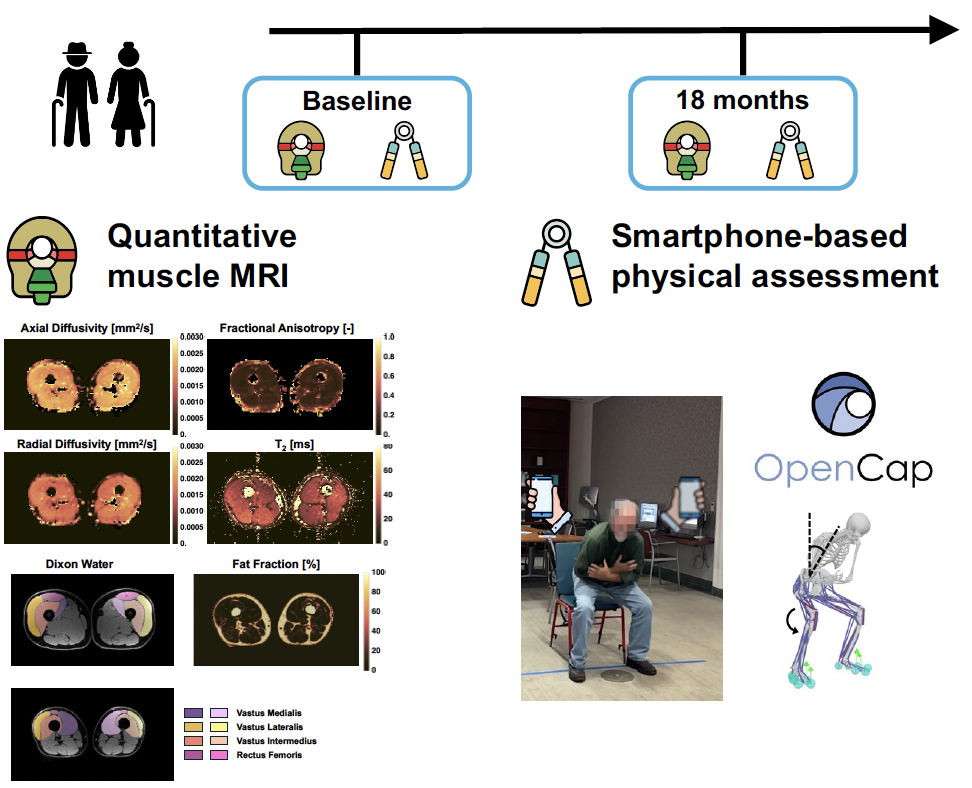
In this project, we seek to develop and validate advanced quantitative MRI techniques to assess compositional and structural changes in skeletal muscles of older adults and to understand how these changes affect muscle function.

Sarcopenia, an age-related condition characterized by the loss of muscle mass and strength, can significantly impact mobility and quality of life in older adults. Early detection is critical, as several rehabilitation strategies are most effective before irreversible muscle loss occurs. Our research focuses on identifying the earliest signs of sarcopenia and determining which changes in muscle composition and structure can predict future declines in muscle strength and function.


Keywords
  • Aging
  • MSK
  • Quantitative MRI
Project Team
External Collaborators

Publications

  1. Mazzoli V, Vainberg Y, Hall ME, et al. Improved Strength Prediction Combining MRI Biomarkers of Muscle Quantity and Quality. NMR Biomed. 2025;38(9):e70112. doi:10.1002/nbm.70112
  2. Barbieri M, Hooijmans MT, Moulin K, Cork TE, Ennis DB, Gold GE, Kogan F, Mazzoli V. A deep learning approach for fast muscle water T2 mapping with subject specific fat T2 calibration from multi-spin-echo acquisitions. Sci Rep. 2024;14(1):8253. doi:10.1038/s41598-024-58812-2
  3. Hooijmans MT, Schlaffke L, Bolsterlee B, Schlaeger S, Marty B, Mazzoli V. Compositional and Functional MRI of Skeletal Muscle: A Review. J Magn Reson Imaging. 2024;60(3):860-877. doi:10.1002/jmri.29091

Acknowledgements

This work was supported by NIH grant K99/R00AG071735  “Quantitative assessment of early structural and functional changes in aging skeletal muscle”.